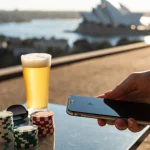
Offshore Casinos for Australian Players: Mobile Access
 Available in AU

A practical look at mobile access, operator claims, bonus conditions and crypto payments in the context of Australian rules.
Table of Contents
- How Offshore Casino Access Works on Mobile
- What an Offshore Casino Site Can—and Cannot—Prove
- Australian Rules, Offshore Operators and the US Search Confusion
- What a 2026 Offshore-Casino Comparison Can Actually Establish
- Reading “Top” and “List” Claims Without Mistaking Them for Evidence
- No-Deposit Bonuses: The Conditions Behind the Headline
- Crypto Deposits and Withdrawals: Timing Is Only Part of the Story
How Offshore Casino Access Works on Mobile
On an Australian phone, access to an offshore casino is generally a browser task, not an app-store download. Most mobile casino sites open in a browser, and the account used there is the same one available on desktop. That means the phone is displaying the site rather than running a separate, store-installed casino application.
The distinction matters because “mobile casino” can describe several different things. A site may be designed to load in a mobile browser; it may offer a Progressive Web App (PWA) that adds an app-like shortcut; or it may provide a native app. Those options are not interchangeable. A familiar icon on the home screen does not, by itself, mean a separate native application has been installed.
Browser access: the default route
For most Australian mobile users, the practical starting point is the casino’s website in a browser. The browser loads the site, and the punter signs in to the existing account. There is no separate mobile account simply because access has moved from a computer to a phone.
This arrangement is also why a site can work on a phone without appearing in an app store. Casino apps are seldom available through Google Play or Apple’s App Store in Australia, so browser access is the ordinary route. The site may present a mobile-oriented layout, but it remains a website reached through the browser.
I find it useful to separate the access method from the label used in a promotion. “Mobile app” can sound like a native download, while the actual product may be a browser page or a shortcut to that page. The label says little about how the software is installed. The route does.
A browser-based session also avoids the assumption that an app must be installed before the account can be used on a phone. The account remains the point of continuity between devices. The browser is the access layer; it is not a new account or a different version of the punter’s identity.
Instant Withdrawal Casinos in Australia: Payouts
What a PWA adds
A Progressive Web App, or PWA, is a website shortcut that behaves more like an app on a mobile device. When the casino website offers an install or add-to-home-screen prompt, the user can tap it and confirm. The resulting icon provides a direct way back to the site.
That shortcut can make the experience feel more app-like, but it should not be confused with a native app downloaded from an official store. The PWA is tied to the website. Its purpose is to make that website easier to open from the device, not to establish that the casino has a separate application in an app marketplace.
The difference is practical. With ordinary browser access, the punter opens the browser and visits the site. With a PWA, the punter can start from a home-screen icon. In both cases, the casino website remains central. The shortcut changes the entry point, not the basic nature of the service.
An install prompt is also a prompt, not proof of quality or safety. It indicates that the site offers a way to add a shortcut; it does not settle questions about the operator or the account. Those are separate matters from how a page is reached on a phone.
Real-Money Pokies on Android in Australia: How They Work
Native apps and sideloading
A native app is installed as an application on the device, rather than being accessed as a website or saved as a PWA shortcut. For Australian users, this is not the usual route for casino access: these apps are rarely listed in the major app stores, and browser play is the default.
If a site directs users to install an app outside an official store, that is sideloading. It carries security risks, and its safety depends on the operator. An installation file should not be treated as trustworthy simply because a casino site provides it. An app-like appearance is not a security credential.
This is one reason I do not treat “download the app” as an automatic upgrade over browser access. A native app may be presented as more convenient, but the installation route and the operator’s handling of it still matter. Where the app is not obtained through an official store, the punter has fewer familiar signals to rely on. Convenience is not verification.
Sideloading Risks
Installing casino apps via sideloading carries security risks; an app-like appearance is not a security credential.
Access is not the same as availability
A page opening on a phone does not establish that the service is available to someone in every location. Offshore casinos accepting Australian players commonly rely on browser access or a PWA rather than a native app, but the device method alone cannot confirm location eligibility. The site must confirm that it accepts the punter’s location before any deposit.
Trying to reach a blocked casino through a VPN can also create a separate account risk: winnings may be voided and the account closed. A change in apparent location is not a reliable fix for an access problem. Nor does a working browser page guarantee that a dispute can be taken to an Australian government body; there is no Australian government body to complain to if an offshore casino refuses to pay winnings.
The useful distinction is modest but clear: browser access loads the casino website; a PWA adds a home-screen shortcut to that website; a native app is installed software. In Australia, the browser is the common route, while app-store availability is limited. Different doorways. Same caution.
What an Offshore Casino Site Can—and Cannot—Prove
“Offshore” describes a relationship between an operator and the country where its customer is located. It does not, by itself, tell much about the operator’s identity, the scope of its permission, or whether an Australian address is eligible to register. The word is a label, not a finding.
Inclave Casinos in Australia: Access and Offers
That distinction matters because a site can present a polished explanation of its status without establishing every point a punter might infer from it. A stated jurisdiction tells where the operator says its licensing connection lies. It does not automatically prove that the licence is current, that it covers the service being offered, or that the operator accepts customers in Australia. Those are separate claims, and each needs to be read on its own terms.
Common licensing jurisdictions associated with casinos that accept Australian players include Curaçao, the Malta Gaming Authority (MGA) and Gibraltar. Naming one of these places is not the same as demonstrating a particular site’s standing there. Nor does a jurisdiction’s name settle whether a particular operator can serve a person located in Australia. A site’s own description is a starting point for interpretation, not a complete answer.
What the jurisdiction label tells you
A jurisdiction label can identify the regulatory setting an operator claims for itself. It can also help distinguish the operator’s claimed licensing connection from its intended customer market. Those two things are often blurred in promotional copy: a site may make a foreign licence sound like a universal passport to serve customers anywhere.
It is not. A licence claim and location eligibility answer different questions. The first concerns the operator’s asserted status in a named jurisdiction. The second concerns whether the site will accept a customer from a particular place. A site might state a jurisdiction clearly while leaving Australian eligibility vague, buried in terms, or absent from the page being viewed.
The phrasing deserves attention. “Licensed in” names a claim about the operator. “Available to” suggests a claim about customer access. Neither phrase proves the other. A logo, a flag, or the name of a regulator can make the first claim look settled while saying nothing useful about the second.
Common Jurisdictions
Casinos accepting Australian players often name Curaçao, the Malta Gaming Authority (MGA), or Gibraltar as their licensing jurisdictions.
In my experience, the persuasive part is often the least informative: a regulator’s name presented as a trust symbol. The useful part is the precise statement that follows it. Which entity is said to hold the licence? What service does the statement cover? Does the site explain the customer locations it accepts? If those details are not clear, the label has not answered the practical question.
What a licence display cannot settle
A footer badge may look official and still leave essential matters unresolved. A page can show a licence number, a seal, or a link while offering no clear explanation of the relationship between the named licensee and the website’s operator. Even where a site makes a detailed claim, the claim should not be mistaken for independent confirmation merely because it is displayed prominently.
The same applies to phrases such as “regulated,” “verified,” or “trusted.” These are conclusions, not the supporting evidence. A reader assessing a site’s status needs to separate the statement from what the statement actually establishes. The operator’s own wording can show what it wants customers to believe; it does not independently prove that every aspect of the claim is accurate or relevant to an Australian customer.
That is the difference between a site making a claim and a site proving one. Proof would need to connect the operator, the licence claim and the service in question in a way that can be checked. Even then, such a connection would not, by itself, establish that an Australian location is accepted. The questions do not collapse into one another.
Best Casino App for Android in Australia: What It Means
I have seen this confusion arise from one small word: “licensed.” Readers can take it to mean “safe for me to use,” “available where I live,” and “protected if something goes wrong.” Those are much broader conclusions. A licence statement alone should not be stretched to carry them.
Australian eligibility is a separate statement
A site may use the language of an offshore casino while still not clearly state whether it accepts customers located in Australia. “International,” “global,” or “available worldwide” is not a substitute for a location-specific eligibility statement. Broad language can sound inclusive without resolving an individual country’s position.
For an offshore crypto-friendly casino, Australian location eligibility must be confirmed before any deposit. The sequence matters: a payment method, account page or welcome message should not be taken as confirmation that the site accepts the customer’s location. The site’s terms and registration rules need to be read for that point specifically. If they are unclear or contradictory, the uncertainty remains; a general licence label does not fill the gap.
Nor does a successful account creation necessarily clarify every condition attached to an account. Registration is an action the site permits at that moment; it is not a broad certification of the operator’s status or of future account treatment. The more consequential the claim, the less useful it is to infer it from a screen that was designed to move a user along.
“Best” is another word that needs restraint. A site may be described as one of the best offshore casino sites, but a ranking does not demonstrate that its licence claim is accurate or that Australians are eligible. That is true whether the claim appears in an operator’s own material or in a comparison. A favourable label answers a question of presentation. It does not answer a question of status.
Do
- Read the terms for location-specific eligibility
- Verify the operator’s licensing claim
- Check the registration rules for contradictions
Don’t
- Rely on broad terms like “global” or “international”
- Assume a country menu confirms eligibility
- Trust a ranking as proof of legal status
What the label says about protection
A foreign licensing claim should not be read as a promise of a local complaint route. If an offshore casino refuses to pay winnings, there is no Australian government body to complain to about that refusal. That is a practical limit worth keeping distinct from whatever licence a site says it holds. A jurisdiction name on a page does not create an Australian government channel for resolving a dispute.
This is why “licensed” should not be used as shorthand for “there is someone here who will make the operator pay.” The site’s status, the place where a complaint might be handled, and the customer’s ability to obtain a remedy are separate matters. Promotional copy tends to compress them. Careful reading puts them back apart.
The same caution applies to a claim that a site is “secure” or “protected.” Those words can refer to different things and may be left undefined. They do not establish that a customer can recover funds following a dispute, or that a local authority supervises the customer relationship. A reassuring adjective is not a remedy.
I would treat any assurance as incomplete until its meaning is specific. “Protected by a licence” is not enough to identify who provides the protection, what it covers, or how a customer can use it. If the answer is not stated plainly, the reassurance is doing more work than the evidence.
Casinos Not on BetStop in Australia: What It Means
Access is not endorsement
A site loading on a device, displaying Australian currency, or presenting payment options does not establish that it is suitable for Australians. Availability on a screen is a technical fact about access, not a finding about licensing, eligibility or recourse. Those distinctions can be easy to miss when a site is designed to make the path from landing page to account feel seamless.
Using a VPN to access a blocked casino may void winnings and lead to account closure. A location workaround does not turn an unclear eligibility claim into a clear one. It can instead introduce another dispute about how the account was accessed. That is a bad foundation for relying on any promise displayed by the site.
The word “offshore” can therefore be useful only when it stays descriptive. It can signal that the operator’s claimed licensing connection is outside Australia. It cannot, on its own, certify the operator, confirm Australian access, or explain what happens when a dispute arises. Those limits are not fine print. They are the substance.
Read the label narrowly. Separate the claimed jurisdiction from the customer-location statement, and separate both from the question of redress. A site may offer a confident description of itself. Confidence is not verification.
Australian Rules, Offshore Operators and the US Search Confusion
The Australian position turns on where the customer is, not on what a website calls itself. Under the Interactive Gambling Act 2001, operators are prohibited from offering online casino-style games to people in Australia. That covers services such as online poker and table games as well as casino games generally. A site’s overseas location or description does not, by itself, change that restriction.
Legal Distinction
Under the Interactive Gambling Act 2001, providing online casino-style games to people in Australia is prohibited for operators, though playing is not illegal for the individual.
The law draws an important distinction between the operator and the individual. The Act prohibits the operator from providing the service to people in Australia; playing at an offshore casino is not itself illegal for an individual Australian player under that Act. Those are different legal positions. Treating them as interchangeable creates confusion: the fact that an individual player is not liable under this law does not mean the operator is permitted to serve Australian customers, or that the service is authorised locally.
That distinction is easy to lose in promotional language. “Available in Australia” can mean only that a page loads, an account form accepts details, or a payment option appears. It is not proof that the operator may legally offer the service to Australians. Nor does a site’s decision to accept a registration settle its legal status. The operator’s conduct and the individual’s position need to be kept separate. Plainly so.
What “offshore” tells—and does not tell
“Offshore” describes an operator based outside Australia. It does not identify a single legal regime, and it is not a quality mark. In ordinary use, the label can cover businesses in different jurisdictions and with different operating arrangements. On its own, it says nothing conclusive about whether a particular site is permitted to accept customers located in Australia.
The same caution applies to broad claims about an offshore gambling casino. A website may use “international,” “global” or “available worldwide” to describe its reach, but those phrases do not override Australian restrictions. A service can be accessible from a device and still be subject to blocking or other enforcement. Access and permission are separate questions.
Pokies Open Near Me in Australia: Casino Hours
I learned to treat the wording on a landing page as a statement by the operator, not as a ruling by a regulator. The distinction matters because a commercial site has an interest in making registration look straightforward. A country appearing in a menu, or a page written for Australian visitors, cannot establish that the operator is entitled to provide online casino games here.
Why United States references cause confusion
References to US offshore casinos can mean different things. They may point to a site operating outside the United States, a business targeting US customers, or a general discussion of operators based beyond a particular country’s borders. The phrase is not a reliable description of one legal status. It also does not establish that a site accepts Australians or may serve them.
US-focused material should not be read as a guide to Australian rules. A site’s position in relation to the United States does not answer the Australian question: whether an operator is offering prohibited online casino-style games to people physically in Australia. The location of the punter is central to that distinction. A US-facing brand, a US search result or an overseas corporate address does not create an Australian exemption.
The reverse is true as well. A site described as Australian-facing is not thereby an Australian-authorised service. Language, currency, customer support and marketing can be tailored to local audiences without changing the legal framework. Labels travel easily across borders. Legal permission does not.
Access can be blocked
The Australian Communications and Media Authority actively blocks access to illegal gambling sites. That means a site being unavailable from an Australian connection is not necessarily a technical fault or a temporary browser problem. Blocking is part of the enforcement environment, and availability can change.
VPN Risks
Using a VPN to access a blocked casino may lead to winnings being voided and the account being closed.
Trying to get around a block with a VPN does not make the underlying service lawful for the operator to offer in Australia. It can also create practical account risks: using a VPN to access a blocked casino may lead to winnings being voided and the account being closed. A connection workaround is not a legal clearance. It may instead make the account’s location harder to establish and leave the punter with less recourse if there is a dispute.
There is no Australian government body to complain to if an offshore casino refuses to pay winnings. That limitation is easy to overlook when a site presents a polished support process or says that it serves customers internationally. A support channel is not the same thing as an Australian regulator with authority to resolve an individual payout dispute. The absence of that local route is a material risk, not a footnote.
For the same reason, a site’s acceptance of a registration or deposit should not be treated as a government endorsement. An operator’s terms and its own customer-service decisions do not replace public oversight. If the service is offshore, the ordinary assumption that a local authority can intervene may not hold.
Age and eligibility
Australian gambling services are restricted to adults: a person must be at least 18 to register and gamble. That age threshold does not make an offshore casino lawful for an operator to offer in Australia. Age eligibility and the operator’s legal position are separate checks, not alternatives to one another.
Casino Apps in Australia: Access, Apps and Risks
Any offshore, crypto-friendly casino presented in connection with this subject remains an offshore service; the description is not a recommendation or a claim of Australian approval. Before any deposit, the site must confirm that it accepts the person’s location. A registration page that lets someone proceed is not enough to establish that point. If location eligibility is unclear, the uncertainty should not be resolved by trying to bypass a block.
I have seen how a simple “yes” on a sign-up screen can be mistaken for a settled answer. It is not. The operator’s restrictions, the customer’s location and any access block are different parts of the picture. A smooth interface can hide that complexity. The law does not follow the interface.
This is the narrow but important distinction behind the Australian position: the Act prohibits operators from providing online casino-style games to people in Australia, while it does not make an individual player’s participation at an offshore casino illegal under that Act. Neither point turns an offshore site into a locally authorised service. And neither a US association nor a working link changes the rules that apply in Australia.
What a 2026 Offshore-Casino Comparison Can Actually Establish
A comparison of offshore crypto-friendly casinos can establish only what its evidence supports: whether a site states that it accepts Australian residents, what jurisdiction it names, and what its published payment terms allow.
A licence reference is a detail to verify, not proof that a casino may legally serve people in Australia. Common jurisdictions named by casinos that accept Australians include Curaçao, the Malta Gaming Authority and Gibraltar. Those names describe where an operator says it is licensed; they do not establish Australian approval or guarantee that the site will accept a particular location.
Comparison Limits
- A licence reference is not proof of Australian approval
- Location eligibility must be confirmed before any deposit
- Payment routes for deposits may differ from withdrawal methods
- No ranking removes the risk of account restrictions or blocked access
The practical test is narrower. An offshore crypto-friendly casino must confirm Australian location eligibility before any deposit. A general claim that a site serves international customers is not the same as confirmation that Australian residents can register, deposit and withdraw under its terms. Eligibility can also be distinct from whether a payment method is available.
Payment conditions matter because the route used to deposit may not be available for cashing out. A specialist review reports that some casinos require withdrawals through the deposit method, while other methods are deposit-only.
No comparison can turn an offshore operator into a locally approved service. Nor can a ranking remove the risk of blocked access, account restrictions or a disputed payout. Using a VPN to reach a blocked casino may void winnings and lead to account closure. There is also no Australian government body to complain to if an offshore casino refuses to pay. Rankings are a starting point. Terms decide the rest.
Reading “Top” and “List” Claims Without Mistaking Them for Evidence
Choosing an offshore casino from Australia calls for attention to the information available about its licensing and practical details. Use these short verdicts as a starting point when reviewing the options.
1. GoldenCrown
License: Curacao Gaming Control Board OGL/2023/176/0095 (Hollycorn N.V.) GoldenCrown lists a Curacao Gaming Control Board licence, OGL/2023/176/0095, held by Hollycorn N.V.
2. Bizzo Casino
License: Curacao Gaming Control Board (TechSolutions Group N.V.) Bizzo Casino lists a Curacao Gaming Control Board licence associated with TechSolutions Group N.V.
3. LevelUp Casino
License: Curacao eGaming OGL/2023/174/0082 (Dama N.V.) · Min. deposit: A$15 LevelUp Casino lists a Curacao eGaming licence, OGL/2023/174/0082, held by Dama N.V. Its stated minimum deposit is A$15.
4. Wild Tokyo
License: Curacao · Payout speed: crypto 30-60 minutes, fiat 1-5 days · Min. deposit: A$10 Wild Tokyo lists a Curacao licence. Its stated payout speed is 30–60 minutes for crypto and 1–5 days for fiat; the minimum deposit is A$10.
5. LuckyVibe
License: Curacao Gaming Control Board OGL/2023/176/0095 (Hollycorn N.V.) LuckyVibe lists a Curacao Gaming Control Board licence, OGL/2023/176/0095, held by Hollycorn N.V.
6. Golden Pokies
License: Curacao Golden Pokies lists Curacao as its licensing jurisdiction.
7. JustCasino
License: Curacao Gaming Control Board JustCasino lists a Curacao Gaming Control Board licence.
8. Vegaz Casino
License: Curacao OGL/2024/1335/0780 · Min. deposit: EUR 20 Vegaz Casino lists a Curacao licence, OGL/2024/1335/0780. Its stated minimum deposit is EUR 20.
9. DragonSlots Casino
License: Curacao Gaming Authority (Jumpman Gaming Ltd) DragonSlots Casino lists a Curacao Gaming Authority licence associated with Jumpman Gaming Ltd.
10. Thor Casino
License: Curacao – Antillephone N.V. (Versus Odds B.V.) · Min. deposit: EUR 20 Thor Casino lists a Curacao licence through Antillephone N.V., associated with Versus Odds B.V. Its stated minimum deposit is EUR 20.
A page headed “top offshore casinos” can look like a comparison while offering little more than a sequence of names. I have seen how easily a ranking label does the work that the underlying checks should do: it suggests that someone has weighed the options, without showing what was measured or whether the result applies to Australian punters.
A usable comparison makes its basis visible. It separates claims that can be checked—such as the stated withdrawal rules—from promotional language such as “best” or “trusted”. It also explains what was not established. A name appearing on a list is not proof that the site accepts someone’s location, that its payout conditions are workable, or that a ranking reflects any consistent method.
For an offshore crypto-friendly casino, Australian location eligibility needs to be confirmed before any deposit. That is a practical condition, not a detail to infer from a country selector or a list entry. A VPN should not be treated as a workaround: using one to reach a blocked casino may void winnings and lead to account closure. And if an offshore casino refuses payment, there is no Australian government body to complain to about that operator.
iPad Casinos in Australia: Games and Access
The same distinction applies to payout claims. A list may show a payment method or describe withdrawals as “fast”, but that phrase does not establish when funds become payable or what steps come first. First withdrawals commonly involve KYC checks, which can include identity evidence such as a selfie or ID, alongside proof of address. That is a separate part of the process from the operator’s own handling time.
Limits matter too, but figures need context. A specialist review has reported weekly withdrawal limits in the $4,000–$10,000 range at some casinos; that is a report about some sites, not a market-wide rule or a promise of access to those amounts. A list that repeats a figure without naming its scope or explaining its conditions leaves the most important point unresolved: whether the stated limit applies to the account and circumstances being compared.
I also treat “independently ranked” as a claim to inspect, not a finding in itself. The page should make clear what criteria were used, whether each entry was assessed on the same basis, and whether commercial relationships could affect placement. If it does not, the order may be editorial decoration. A longer list does not fix that.
Before Claiming Bonuses
- Check wagering requirements
- Review eligible games
- Confirm expiry dates
- Check for cashout caps
There is a further gap between inclusion and suitability. A site can appear in a collection without the collection establishing its location rules, withdrawal process or recourse if a dispute arises. A disclaimer does not turn an unsupported ranking into evidence. Nor does a polished table.
Before claiming a bonus, the terms need to be read for wagering requirements, game restrictions, expiry dates and cashout caps. Those conditions can change what an offer is worth, even when its headline looks generous. “Listed” is not the same as “checked”.
No-Deposit Bonuses: The Conditions Behind the Headline
“No deposit” describes how an offer is entered, not whether its bonus can be withdrawn as cash. The operative terms sit behind the headline: wagering requirements, eligible games, an expiry date and any cap on cashout. Each can change the practical value of the offer.
A specialist casino review reports welcome-bonus wagering requirements in the 30x to 50x range and treats requirements above 40x as steep. Those figures are a review’s assessment, not a universal rule. The multiplier also needs to be read alongside its base: terms may calculate wagering against the bonus, or against a combined bonus-and-deposit amount. That distinction changes the work required, so the calculation should be stated plainly in the offer rules.
“No deposit” can still come with a substantial play-through obligation. A punter may complete the stated wagering and then find that some games contributed less, or did not qualify at all. The promotional headline does not settle that question. The game-contribution rules do.
Time limits matter just as much. A specialist casino review reports that many bonuses have a seven-to-ten-day clearance window; an uncompleted requirement by the deadline can mean forfeiting the bonus. The exact expiry must be checked in the terms, rather than inferred from another offer.
Before claiming, the full conditions should be read for wagering requirements, game restrictions, expiry dates and cashout caps. A cap may limit the amount withdrawable even after the wagering condition is met. The distinction is easy to miss: clearing a bonus is not necessarily the same as being able to withdraw everything displayed in the balance.
Australian Pokies Parlour Casinos: Venue or Online?
I have seen “free” do a lot of work in promotional copy. It describes the entry cost. The conditions decide the rest.
Crypto Deposits and Withdrawals: Timing Is Only Part of the Story
Crypto can be a deposit route at an offshore crypto-friendly casino, but a transfer reaching the operator’s wallet does not settle every question about getting funds back. The site must confirm that it accepts Australian players before any deposit. There is no Australian government body to complain to if an offshore casino refuses to pay winnings.
The useful distinction is between processing and permission to withdraw. A specialist review describes crypto and e-wallet withdrawals as being processed in under 24 hours, but that timing does not account for identity checks, an operator’s pending period, or limits and rules attached to the account. Processing speed is not the same as money received.
On a first withdrawal, expect KYC checks to be part of the process. These can require identification or a selfie, along with proof of address. Until the operator accepts those documents, a payment request may not move forward. The name and details on the account and submitted documents therefore matter as much as the transfer method.
I have seen “instant crypto withdrawals” used as a headline for a step in the payment chain, not a promise that the full withdrawal will be immediate. The blockchain transfer, the casino’s review, and any verification are separate stages. Read the withdrawal rules before depositing, especially where the site specifies which methods can receive payouts.
A VPN is not a workaround for an access block: using one may void winnings and lead to account closure. Nor does choosing crypto remove that risk. Keep the payment record and the operator’s written withdrawal conditions. If those conditions leave the route back to the punter’s wallet unclear, the speed claim tells only half the story.
Is it safe to play at mobile casinos in Australia?
Browser play is the usual way to access offshore casinos, but that does not prove an operator is safe. Installing an app from outside an official store carries security risks, and an install prompt or app-like appearance is not proof of trustworthiness.
Are mobile-only promotions worth it?
They can be worth considering if the wagering requirement, minimum deposit and deadline suit you. Welcome bonuses commonly require wagering the bonus amount 30 to 50 times; requirements above 40x are steep, and many offers expire within 7–10 days.
Is it safe to use mobile casinos?
Using a mobile browser is the common access route, but it does not establish that a casino operator is safe. Be cautious with apps installed outside official stores, as sideloading carries security risks.
Is mobile casino gambling legal in Australia?
The Interactive Gambling Act 2001 prohibits operators from offering online casino-style games to people in Australia, but it does not make it illegal for individual Australians to play at offshore casinos.
How do wagering requirements actually work in practice?
A requirement of 30x to 50x means wagering the bonus amount that many times; anything above 40x is considered steep. Many bonuses must be cleared within 7–10 days, or the bonus is lost.
Casino Access

Australian Mobile Casinos: Access, Payments and Risks
Mobile access can mean a browser site, a home-screen web app or a native app,...

Best Casino App for Android in Australia: What It Means
Australian casino play on Android often uses a mobile website or Progressive Web App, with...

Casino Apps for iPhone in Australia: What to Expect
Australian-facing iPhone pokies often run through a mobile website or home-screen shortcut, rather than a...

Casino Apps in Australia: Access, Apps and Risks
The guide separates offshore real-money access from free-play apps and explains device options, bonus terms,...

Casinos Not on BetStop in Australia: What It Means
BetStop is a register enforced through participating operators, while offshore platforms sit outside its exclusion-checking...

Instant Withdrawal Casinos in Australia: Payouts
Withdrawal speed depends on casino review and the payment provider, so an instant-processing claim may...

International Casinos for Australian Players: What to Know
International licensing, real-money mechanics and access limits are considered separately from whether a service may...

Inclave Casinos in Australia: Access and Offers
The guide distinguishes authentication from licensing and availability, while treating casino, bonus and mobile claims...

iPad Casinos in Australia: Games and Access
Game availability depends on developer adaptation, not simply whether a casino page opens in the...

Real-Money No-Deposit Online Pokies in Australia
The guide separates free spins from real-money play and explains legal, bonus, mobile, PayID and...

Online pokies with e-wallets in Australia: access
The guide separates phone access from payment handling and explains browser play, deposits, withdrawals and...

Pokies Open Near Me in Australia: Casino Hours
Major casinos operate around the clock, but individual services, local venues and holiday arrangements may...

Australian Pokies Parlour Casinos: Venue or Online?
A parlour name may describe a physical gaming area or simply appear on a website,...

Real-Money Pokies on Android in Australia: How They Work
Android games can look alike, but deposits, cash balances and withdrawals distinguish gambling accounts from...

Real-Money Pokies in Australia: Apps or Browser?
Mobile casino access may use a browser, a saved PWA or a downloadable app, with...

VPN-Friendly Casinos in Australia: Access and Limits
A practical framework for weighing VPN routing, offshore casino claims, Australian rules and payment realities...